

PAINTLESS DENT reMOVAL
Same-Day Estimates Available
Paintless Dent Removal in Central Ohio
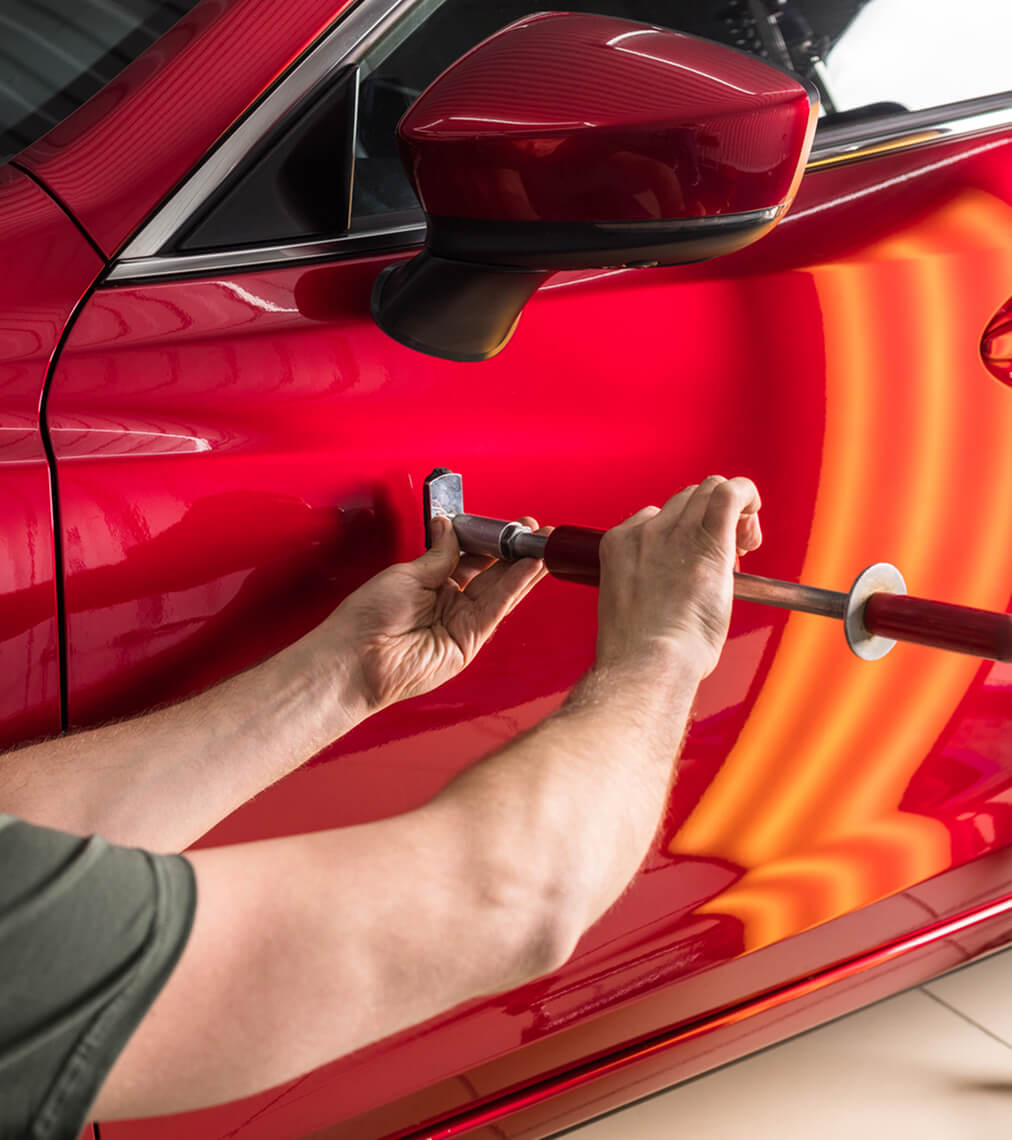
Those stripes are a reflection board. Where the lines bend is where the metal is still low — and when they run straight, the dent is gone.
Paintless dent removal fixes a dent without ever opening a paint can. Working from behind the panel with a set of shaped rods, a technician eases the metal back to where it started — one tiny push at a time — while the finish on the outside stays put. There is no filler, no sanding and no spraying. The panel you drive away with is still wearing the exact paint the factory put on it.
That matters more than it first appears. A carmaker bakes paint onto bare steel in a plant, with corrosion coatings and heat no body shop can copy after the car is built. Even a flawless refinish is a careful imitation of that original. So when a dent can be lifted out without cracking the finish, it isn’t only the quicker, cheaper route — it’s the higher-quality repair. It’s also the first thing we look for before pricing anything else. There’s more on how we make that call on our dent repair page and in how we follow OEM repair standards.
Not Drivable? Let Us Bring It In.
Free local towing is available to qualified customers based on location — just mention it when you open your case. Rental vehicles are available too, so you are not left sorting out a ride while your vehicle is with us.
Start Your RepairWhat Decides Whether PDR Will Work
Two dents can look nearly the same from across the parking lot and only one of them will take a paintless repair. Here is what we’re really weighing when you bring the car in:
- Whether the finish is truly intact — a crack too fine to catch at arm’s length is still enough to rule PDR out
- Whether you’re looking at a soft depression or a hard crease; a crease means the metal stretched, and stretched metal doesn’t just spring back
- How deep the push went — severe dents can be improved, but not every one comes back to a showroom finish
- Whether we can get a tool to the back of the panel, or trim, bracing and bonded structure block the way
- Where the dent landed — edges and body lines are the stiffest parts of a panel and the slowest to move
- What the panel is — aluminium remembers its shape less willingly than steel, so it’s slower work with a lower hit rate
- Whether that spot has been repainted before; refinished panels don’t flex the way untouched factory paint does
Why Drivers Choose T&C for Paintless Dent Removal
- PDR is the first thing we check, every time. It’s the smaller job and the cleaner result. If your dent qualifies, we’ll tell you — instead of quoting a refinish because it bills more.
- A plain answer on what’s achievable. Some dents vanish; some come back ninety per cent of the way. You’ll know which one you’ve got before you say go, not afterward.
- Factory paint stays factory. No filler, no primer, no blend into the next panel and no new paint edge waiting to fail somewhere down the road.
- Built for hail. A storm scatters dozens of small dents across a hood, roof and trunk — exactly what paintless removal was made for. See hail damage repair.
- When PDR is wrong, we say so. Forcing a paintless fix onto damage that needs conventional work leaves a panel that looks almost right — which is worse than doing it properly.
- Free assessment, up-front pricing. The recommendation and the price are yours before we start, and the car comes back washed and vacuumed.
Quick Paintless Dent Removal Questions
The questions we field most about PDR. If yours isn’t here, call the shop at (614) 471-0505 — we’re glad to walk you through it.
What exactly is paintless dent removal?
It’s a way of pushing a dent back out from behind the panel with shaped rods and tips, leaving the paint alone. When there’s no way in from behind, small tabs can be glued to the outside and the dent pulled out from the front instead. Either method skips filler, sanding and spraying entirely, so the factory finish comes through untouched.
How do I know if my dent qualifies?
As a rule of thumb: if the paint is unbroken, the dent is a smooth dish rather than a sharp crease, and there’s a way to reach behind the panel, your odds are good. Door dings, cart dents and hail are the textbook cases. Text us a photo from your phone and we can usually give you an answer before you make the drive.
Can PDR harm the paint?
Done properly, no — not harming it is the whole idea. The metal moves slowly enough that the finish bends along with it rather than cracking. Rushed, on a dent that was never a candidate, paint can split or the surface can pick up high spots. That’s why the assessment counts for more than the technique, and why we’ll turn down a dent that shouldn’t be done this way.
Why is keeping the original paint such a big deal?
Factory paint goes onto a bare body shell under conditions no shop can recreate — dipped, electrostatically coated and baked at heat a finished car couldn’t survive. It’s the toughest, most corrosion-resistant finish the vehicle will ever have. A refinish can match it to the eye and still be an imitation. Keeping the original also means the panel shows no repainted area if the car is ever inspected.
What are those stripes reflected on the panel?
That’s a line board, and it’s the technician’s most useful tool. A dent is nearly invisible head-on but it warps a reflection sharply. By watching how the straight lines bow across the surface, the technician reads the exact shape of the damage and catches the instant the metal returns true — far more precisely than eyes or fingertips could.
How long will it take?
A lone door ding is often an hour or two. Several dents, or one tucked somewhere that needs trim pulled to reach, run longer. Hail spread across multiple panels is measured in days, not hours. Because there’s no paint and no cure time in the process, PDR is nearly always faster than a conventional repair on the same panel.
Is it cheaper than conventional dent repair?
Usually, and often by a good margin, since there are no materials and no refinishing labour. What it costs comes down to the size, depth, location and number of dents rather than a flat rate. You’ll have the figure before we begin — and if the damage turns out not to be a paintless candidate, we’ll tell you that rather than bill you to find out.
Does PDR work on hail damage?
Hail is what paintless removal handles best. Those dents tend to be many, shallow and round, landing on horizontal panels with easy access underneath — and the paint usually survives. It also lets a hail-battered car be put right without every panel ending up with a repainted patch. The exception is a large stone that cracks the paint or creases the metal. See our hail damage page.
Do I need an appointment?
An appointment gets you seen sooner, and you can request one online or send a photo of the dent from your phone. A shot taken at an angle, with a window or light streaking across the panel, tells us a lot more than one taken straight on.


We welcome you as part of our family and are committed to providing you with the highest standards of customized services tailored to your individual needs



Address

Phone

Address
2856 Johnstown Road, Columbus, OH, 43219, USA

Hours of Operation
Monday-Friday: 8:00 AM - 5:00 PM
Share


©2026, Alpha Automotive, LLC
©Copyright 2025, T&C Body Shop