

ADAS CALIBRATION
Same-Day Estimates Available
ADAS Calibration in Central Ohio
The cameras and radar tucked behind your windshield, grille and mirrors are what run lane keeping, automatic emergency braking, adaptive cruise and blind-spot monitoring. Every one of them is aimed to a tolerance measured in fractions of a degree. Nudge one out of place — a windshield swapped, a bumper cover pulled, a structure straightened — and it keeps watching the road, just not the stretch of road its engineer intended. ADAS calibration is how that aim gets reset and proven.
T&C Body Shop runs static and dynamic calibration to the manufacturer’s published procedure for your specific vehicle, using OEM scan tools in-house rather than aftermarket tools alone. We calibrate as part of the repair rather than as an add-on tacked on afterward, and the results land in your repair documentation. It is the most demanding end of how we follow OEM repair standards.
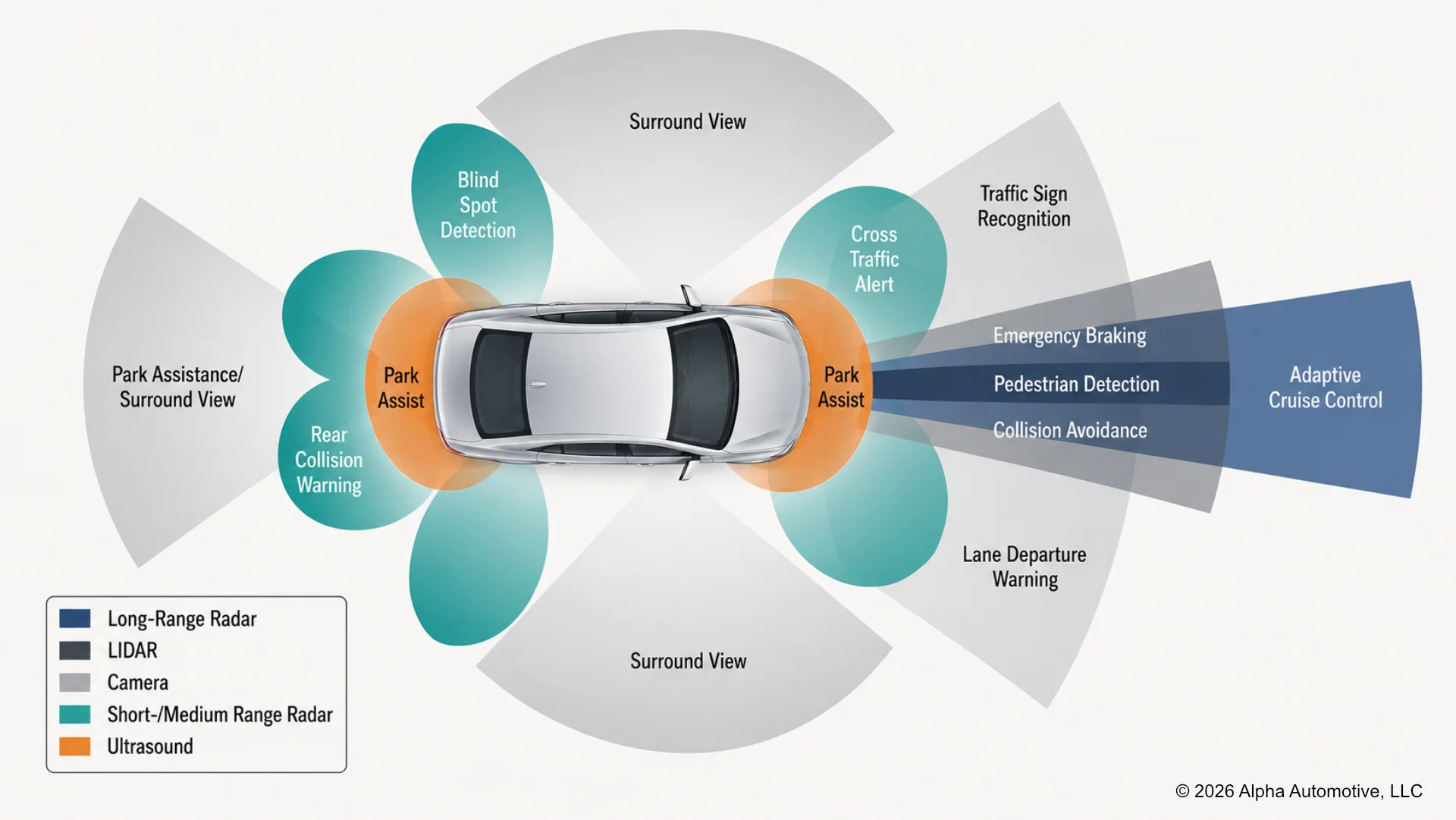
The sensors that keep you between the lines — and the everyday repairs that knock them out of aim. Click to view full size.
Not Drivable? Let Us Bring It In.
Free local towing is available to qualified customers based on location — just mention it when you open your case. Rental vehicles are available too, so you are not left sorting out a ride while your vehicle is with us.
Start Your RepairWhat You Can’t See After a Collision
A miscalibrated safety system gives nothing away. The car drives normally, the dash stays clear, and the feature still seems to work. Here is what goes wrong without a sound:
- A forward camera off by a fraction of a degree — which grows into several feet of error at the distance where braking actually counts
- Blind-spot radar in a rear quarter watching the next lane over, or the curb, rather than your actual blind spot
- Adaptive cruise misreading the lane through a curve, braking for a car that was never in your path
- Lane keeping easing you a few inches off centre, which feels like the road rather than the system
- Parking sensors and 360 cameras referenced to a body panel that now sits a touch differently than before
- A system that quietly switched itself off and won’t come back until it is calibrated — which you discover the day you need it
- Calibration missed altogether because it was never written onto the estimate to begin with
Why Drivers Choose T&C for ADAS Calibration
- OEM scan tools in-house. Many shops lean on aftermarket tools alone. Factory tools read the build data your vehicle actually shipped with — the reference calibration has to be measured against.
- Static, dynamic, or both. Some vehicles need targets positioned at measured distances on a level floor; some need a road drive at a set speed; some need both, in a set order. The manufacturer decides that, not us.
- On the estimate from the start. Calibration belongs in the repair plan from day one, not as a surprise line at the end — and we make the case for it with your insurer.
- I-CAR, ASE, PPG and 3M certified technicians and estimators. The estimating side is where this is won or lost: a calibration that never gets written is a calibration that never happens.
- Documented results. You get the pre- and post-calibration record in your repair file — proof the systems were verified, not merely reset.
- All under one roof. Structural work, glass, refinishing and calibration happen in the same shop, so nothing slips through a handoff to a third party.
Quick ADAS Calibration Questions
The questions that come up most about driver-assist systems after a repair. If yours isn’t here, call the shop at (614) 471-0505 — we’re glad to walk you through it.
What is ADAS calibration?
ADAS stands for Advanced Driver Assistance Systems — the cameras, radar and sensors that run features such as automatic emergency braking, lane keeping, adaptive cruise and blind-spot monitoring. Calibration is the process of re-aiming and re-verifying those sensors to the manufacturer’s exact specification after something has moved them. Skip it and the system still runs, but its sense of where the road is no longer lines up with where the road actually is.
Will a dash light warn me if my safety systems are off?
Usually not, and it’s the single most important thing to grasp about these systems. There is no warning light for “your blind-spot monitor is aimed a little wrong” or “your adaptive cruise is reading the wrong lane.” A sensor can be measurably out of specification while every light on the dash stays dark. The only way to know is to measure it against the manufacturer’s spec.
How do I know whether my vehicle needs it?
Judge it by what was done to the car, not by how it feels to drive. Common triggers include windshield replacement, bumper cover removal or replacement, mirror replacement, suspension or alignment work, ride-height changes, structural repair and airbag deployment. The manufacturer publishes which operations call for calibration on your specific vehicle — we look it up rather than guess.
What’s the difference between static and dynamic calibration?
Static calibration is done in the shop: the vehicle sits on a level floor while precisely positioned targets are set at measured distances and heights under controlled lighting. Dynamic calibration happens out on the road, with the vehicle driven at a specified speed under specified conditions while the system relearns. Some vehicles need one, some the other, and some both in a particular sequence.
Why does a windshield replacement need calibration?
On most recent vehicles the forward camera is mounted to the glass or to a bracket bonded to it. Pull the old glass, fit the new, and that camera has shifted — even by an amount you’d never see. Because it’s looking hundreds of feet down the road, a tiny angle change at the windshield becomes a large error at distance. Our auto glass page shows how the two jobs fit together.
Can bumper work really affect my safety systems?
Yes. Front radar for adaptive cruise and automatic emergency braking often lives behind the bumper cover or in the grille, and parking sensors sit in the cover itself. Removing and refitting that cover — even with nothing visibly damaged behind it — can be enough to require calibration. It’s one of the most frequently skipped steps in collision work, because the damage reads as cosmetic. More on our bumper page.
How long does ADAS calibration take?
A straightforward static calibration often runs a couple of hours. Dynamic calibration adds a road drive that has to meet set conditions — speed, clear lane markings, sometimes weather — so it can wait on traffic or daylight. Vehicles that need several systems calibrated take longer. We build it into the repair timeline and tell you up front rather than springing it on you at the end.
Will my insurance pay for the calibration?
When the manufacturer’s repair procedure requires it, it is part of restoring the vehicle — and that is the case we make. It sometimes shows up on a supplement rather than the first estimate, because the requirement only becomes clear once the repair plan is drawn up. We handle that conversation with your carrier so you are not the one debating a line item you never knew existed.
Can you calibrate if the repair was done elsewhere?
Yes. If another shop did the body work and skipped the calibration — or your glass was replaced and nobody mentioned it was needed — bring it in and we’ll scan the vehicle, check what the manufacturer requires, and calibrate whatever needs it. Request an appointment online, or just call the shop.

We welcome you as part of our family and are committed to providing you with the highest standards of customized services tailored to your individual needs



Address

Phone

Address
2856 Johnstown Road, Columbus, OH, 43219, USA

Hours of Operation
Monday-Friday: 8:00 AM - 5:00 PM
Share


©2026, Alpha Automotive, LLC
©Copyright 2025, T&C Body Shop