
PAINT REPAIR SERVICES
Same-Day Estimates Available
Paint Repair in Central Ohio
Nobody looks at the paint first, and it’s the very thing that exposes a poor repair. A color that’s a shade off, a panel that throws the light differently than its neighbour, a clear coat that hazes after one Columbus winter — those are the giveaways. Automotive paint isn’t a coat of color; it’s a layered system, and matching it to a car that’s been baking in the sun for years is closer to chemistry than to painting.
Whether a collision repair needs refinishing, an earlier shop’s paint has drifted out of match, or stone chips and road rash have worn through the finish, the work underneath is the same: read the color the car actually wears today, rebuild the paint the way the factory stacked it, and blend into the surrounding panels so the eye never lands on an edge. It’s also the step most often rushed — which is why we hold it to the same OEM repair standards as the structural work.
Not Drivable? Let Us Bring It In.
Free local towing is available to qualified customers based on location — just mention it when you open your case. Rental vehicles are available too, so you are not left sorting out a ride while your vehicle is with us.
Start Your RepairWhat You Can’t See in a Paint Job
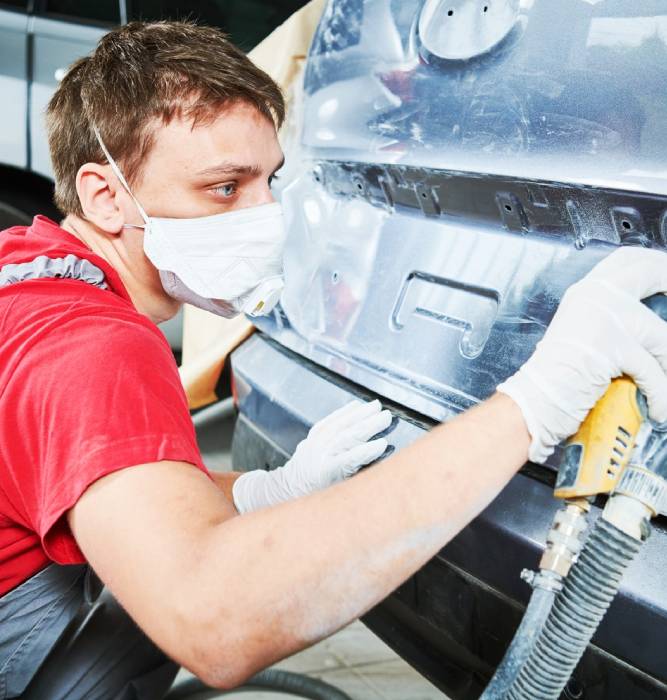
Prep is most of a paint job and none of what you see later — sanded flat, cleaned and primed before a drop of color goes on.
A finished paint repair reads as one smooth, even color. Whether it still reads that way two years on — or starts to stand out, cloud or peel — comes down to steps that are already hidden by the time the car is handed back:
- Whether the color was matched to the car as it is today, or simply mixed to the factory code and sprayed on
- Whether the painter sprayed test cards and read them in daylight before ever touching the vehicle
- Whether the neighbouring panels were blended, or the new paint stops dead at a panel edge where a mismatch shows most
- Whether the surface beneath was truly stripped, cleaned and primed, or painted over contamination that lifts the finish later
- Whether the clear coat was laid in full, even coats and cured properly, or hurried so the car could clear the booth
- Whether the right paint system was chosen for your finish — single-stage, base-coat/clear-coat, metallic, pearl and tri-coat each behave differently
- Whether the booth was clean, because dust cured into clear coat is permanent and only comes out by sanding it back
Why Drivers Choose T&C for Paint Repair
- Matched to your car, not the code. Paint ages in the sun. We match to the actual panel, spray test cards to confirm in daylight, and only then commit color to the vehicle.
- Blended, not walled off. New color is feathered into the adjoining panels rather than halted at a seam, so the repair disappears instead of drawing a line across your car.
- The right system for your finish. Metallics, pearls and tri-coats shift with the light and the angle. We spray them the way they were built, in the correct number of stages, not as one flat coat.
- Prepared and protected underneath. Bare metal is cleaned and primed, corrosion protection is restored, and the finish is built up in proper coats — because rushed prep is what fails first, long after you’ve driven off.
- I-CAR, ASE, PPG and 3M certified technicians and estimators. PPG and 3M certification is refinishing and materials training specifically — which is most of what a paint repair really is.
- Free assessment, up-front pricing, warrantied work. The recommendation and the price are yours before we start, and the car comes back washed and vacuumed.
Quick Paint Repair Questions
The questions we field most about color matching, blending and refinishing. If yours isn’t here, call the shop at (614) 471-0505 — we’re glad to walk you through it.
How do you match my paint color?
We begin at the vehicle’s paint code to land close, then correct from there against the actual panel — because paint on the code and paint on your car are rarely the same after a few summers. We mix, spray test cards, and hold them to your finish in daylight before any color reaches the vehicle. Only once the card vanishes against the panel do we paint the car.
Why not just use the factory paint code?
The code tells us the color the day the car rolled off the line. Sun, heat, road grime and time carry every finish away from that, and two cars sharing a code can sit noticeably apart after a few years. The code is our starting point, not our finish line. Leaning on it alone is precisely how you get a panel that’s technically correct and still plainly wrong beside the rest of the car.
Why does blending matter on a paint repair?
Blending carries the new color a short way into the panels flanking the repair rather than stopping it hard at the seam. Even a near-flawless match can betray itself as a straight line where old meets new; blending feathers that shift across a panel so there’s no edge for your eye to snag on. It takes more material and more labour, and it’s the line between a repair you can’t find and one you can.
Do you repaint the whole panel or just the damaged area?
Whichever gives the cleaner result — and we tell you which before we start. A small chip in a solid color can sometimes be spot-repaired; a scratch across a metallic panel usually calls for refinishing the whole panel and blending into the ones beside it, since metallics are nearly impossible to spot in without a trace. We make the call on your paint type and where the damage sits, not on whatever’s fastest.
What’s the difference between single-stage, base-coat/clear-coat and tri-coat paint?
Single-stage carries color and gloss in one coat and shows up mostly on older vehicles. Base-coat/clear-coat — color first, clear over it — is what almost every modern car wears, and the clear is the layer you actually polish and protect. Tri-coat adds a translucent mid-coat for pearl and candy finishes, so the color moves with the light. Each demands a different spraying approach, and a tri-coat in particular takes extra test panels to nail.
Can you fix clear coat that’s peeling, cloudy or flaking?
Yes — it’s one of the more common paint jobs we take on. Clear-coat failure, whether a milky haze or the top layer lifting and flaking, is usually the finish breaking down after years of sun, and it can’t be buffed back once it starts. The fix is to strip the failed area to a sound surface, refinish it, and blend into the surrounding panels. Caught early, while it’s one panel rather than the whole roof and hood, it’s a smaller job.
How long does paint need to cure before I use the car?
The finish is dry to the touch and safe to drive within hours, and we won’t hand a car back before it is. Fully hardened takes longer — fresh paint keeps curing for a few weeks, so through that window we ask you to skip automatic car washes, harsh chemicals and stick-on badges, and to hand wash gently. We’ll give you the specifics for your repair when you collect the vehicle.
Is factory paint really better than a shop refinish?
Factory paint is baked onto a bare shell at temperatures a finished car could never take, so an original finish that’s still sound is always worth keeping — which is exactly why we steer you to paintless dent removal whenever the finish allows it. When refinishing is truly needed, a properly prepped, correctly cured, professionally blended repair is built to match the factory finish beside it and to last. The gap isn’t the paint; it’s whether the work behind it was done right.
Can you look at it first, or do I need an appointment?
Either works. You can request an appointment online or send a photo of the damage from your phone, and often that’s enough for us to tell you whether you’re looking at a spot repair, a panel refinish or clear-coat work before you drive over. Either way the assessment and estimate are free, and you'll have the number before any work begins.

We welcome you as part of our family and are committed to providing you with the highest standards of customized services tailored to your individual needs



Address
Phone

Address
2856 Johnstown Road, Columbus, OH, 43219, USA

Hours of Operation
Monday-Friday: 8:00 AM - 5:00 PM
Share


©2026, Alpha Automotive, LLC
©Copyright 2025, T&C Body Shop